

Variable Pricing vs. Dynamic Pricing for Tour Operators
For many tour operators, pricing still lives in a spreadsheet. It gets set once a season, locked into a brochure, and revisited only when something goes wrong. But pricing has actually become one of the biggest growth levers in multi-day travel, and the operators pulling ahead treat it that way.
The pressure is real. There’s more complex products, higher traveler expectations for personalization, and tighter margins than ever before. The personalized travel and experiences market grew from $169.33 billion in 2025 and is on track for $198.5 billion in 2026, a 17.2% jump. More tailor-made trips means more variations to price, and more ways to get pricing wrong.
Two models help operators meet that pressure: variable pricing and dynamic pricing. They're often confused and sometimes treated as rivals. The strongest operators use both.
What Is Variable Pricing?
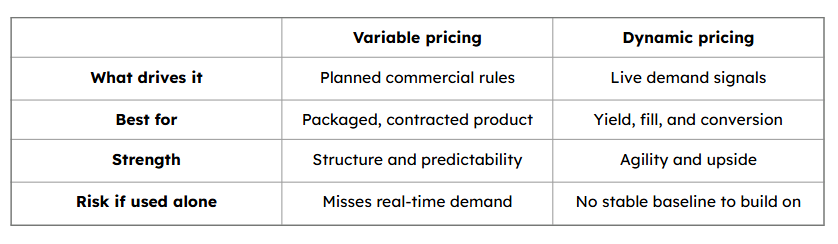
Variable pricing sets rates using known commercial rules: Seasonality, room or cabin category, group-size tier, channel, contracted supplier cost, and commission structure. You define the logic in advance, and the system applies it consistently.
It's the right foundation for packaged, contracted products. A 12-day escorted tour isn't one price; it's a structure built from supplier terms, guide costs, occupancy bands, deposit schedules, and channel rules. Variable pricing encodes that structure so product, finance, and sales teams work from one agreed architecture instead of rebuilding quotes by hand. That reduces redundancies and the spreadsheet dependency that slows complex group and packaged travel.
What Is Dynamic Pricing?
Dynamic pricing adjusts rates in response to live signals: Booking pace, remaining inventory, departure load factors, demand by source market, and campaign windows. Where variable pricing is planned, dynamic pricing is reactive.
This is already standard practice in hospitality and aviation. Drawing on a foundational study of nearly 1,000 hotels across eight European capitals, a 2025 review reports that roughly 90% varied their prices across the booking window rather than holding a fixed rate. Airbnb's own Smart Pricing is the most familiar example of demand-based pricing in travel, and platform data backs the approach: Listings across Your.Rentals that switched on dynamic pricing became 37% more booked than before. Multi-day operators have been slower to adopt — which is exactly the opportunity.
Why Variable Pricing Alone Isn't Enough
A purely variable model is predictable, but it can't react. When a departure sells faster than forecasted, fixed pricing leaves money on the table; when one sells slowly, the instinct is to discount the whole season instead of nudging a single date. The result is missed upside on strong departures and unnecessary discounting on weak ones.
Dynamic pricing closes that gap. It lets operators raise prices when booking velocity beats forecast, add targeted incentives to fill slow departures, and tailor offers by channel or market without repricing everything.
The Strongest Model: Variable as the Baseline, Dynamic as the Overlay
Here's the part that smart operators get: you don't have to choose between pricing models. You can build a structured variable-pricing baseline, then layer controlled dynamic adjustments on top.
The baseline covers contracted costs, planned margin, seasonality, occupancy tiers, commissions, and payment schedules, so the stability product and finance need. The overlay responds to live availability, booking pace, load-factor targets, and campaigns, providing the agility sales and revenue teams desire
The key word is controlled. Dynamic pricing isn't a free-for-all flashing "one seat left" like a budget airline. For premium and tailor-made operators especially, movement happens inside guardrails like early-booking advantages, repeat-customer perks, and value-add incentives like an exclusive upgrade so price reflects demand without cheapening the brand.
A quick example: A seasonal escorted tour is priced by season, room type, group size, and guide cost (variable). One August departure paces 30% ahead of forecast, so the system lifts the price on the remaining seats (dynamic). The season's architecture stays intact; only the hot date moves.
"The point isn't to chase the lowest price. It's to know where you're leaving money on the table and react inside guardrails you set in advance. For premium operators, that often means rewarding early or repeat bookers with something exclusive rather than discounting. The price moves; the brand doesn't." — Unnur Osp Ásgrímsdóttir, VP of Product, Kaptio
What Operators Get from the Blended Approach
- Protected margin. Hold commercially viable base rates and make strategic adjustments instead of blanket discounts.
- Better load factors. Move remaining capacity on specific departures, especially critical when inventory is fixed, as it is on a set cabin block or guided tour.
- Flexible business models. Price escorted tours, FIT extensions, cruise-and-land combinations, and ancillaries on the same operating system.
- Less manual work. Fewer spreadsheets and better coordination across sales, ops, finance, and marketing.
Why Pricing Maturity Depends on Connected Systems
None of this works across disconnected tools. To run variable and dynamic pricing together, an operator needs inventory visibility, booking data, CRM signals, commission logic, and supplier costs in one place. When that data is fragmented, pricing stays static by default.
Kaptio builds revenue management into its core: complex rules for deposits, balances, commissions, seasonality, and group-size logic, with flexible packaging for trips, pre- and post-nights, excursions, and add-ons.
Different operators pull different levers - growth-focused teams chase conversion and new channels, mature teams optimize yield and margin - but both need a platform that supports structure and agility at once.
Pricing Is a Growth Engine, Not a Back-Office Setting
Variable pricing gives you stability. Dynamic pricing gives you responsiveness. Together they give modern tour operators the control and flexibility that multi-day travel demands in 2026.
The goal isn't just to automate prices. It's to help operators sell smarter, fill better, and grow without operational chaos. That's the difference between pricing as admin or pricing as a growth engine.
See how Kaptio handles pricing, packaging, and revenue management in one connected platform.






London, WC1N 2EB
Kópavogur, Iceland
Vancouver, BC, Canada, V6B 5C6

