

Why Cruise Operators Need to Think Like Modern-Day Retailers
Selling a cruise used to mean selling a cabin and an itinerary. It doesn't anymore.
A single booking could include flights, pre- and post-cruise stays, transfers, shore excursions, dining and wellness packages, insurance, specialist equipment, and loyalty-driven upgrades — each one a commercial opportunity and an operational headache. That makes modern cruise look far less like reservations management and far more like retail.
The demand is there to justify the shift.
The Cruise Line International Association projected a total 37.7 million cruise passengers in 2025, up from 34.6 million in 2024, with 82% of past cruisers saying they intend to sail again. Guests now expect personalized offers, self-service flexibility, and consistent service across every touchpoint; all similar offerings found at any good retailer. The cruise brands pulling ahead have stopped thinking of themselves as booking engines and started building connected commerce around the entire guest journey.
Why Traditional Cruise Systems Are Struggling
Most legacy cruise systems were built for static reservations and operational admin (think cabin inventory, manifests, departure management) not for dynamic commerce and guest engagement. That worked when a cruise was a single cabin on a ship priced with a single all-inclusive package. It breaks down when the same operator needs configurable itineraries, dynamic packaging, omnichannel sales, ancillary merchandising, and lifecycle communication running at once.
The real problem isn't a lack of technology; it's fragmentation. Guest data sits scattered across disconnected CRMs, spreadsheets, booking systems, onboard POS, and supplier tools.
When a returning guest's dining preferences live in one system and their excursion history in another, delivering a unified experience becomes manual work.
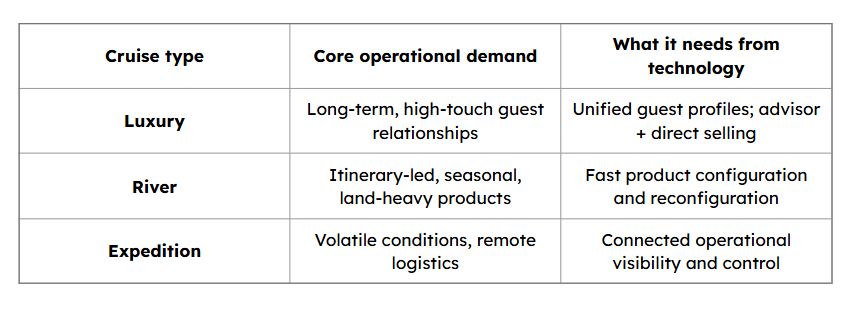
The catch is that there's no single version of the modern cruise retailer. Luxury, river, and expedition operators face very different challenges, and each translates retail thinking (personalization, dynamic packaging, connected commerce) into something specific to its product and guest. Here's how the shift applies to each.
Luxury Cruise Requires Retail-Grade Personalization
Luxury operators aren't selling cabins; they're managing relationships.
A premium booking involves concierge servicing, bespoke itineraries, suite upgrades, private transfers, destination extensions, and a guest history that may span years and several voyages.
Returning luxury guests expect operators to remember their preferences, servicing history, and loyalty behavior across every journey and channel, which is impossible without a unified guest profile underneath.
This segment is also where the money is heading. The luxury cruise fleet has tripled since 2010, from 28 ships to 97 in 2024, and CLIA forecasts 1.5 million travelers will choose a luxury cruise by 2028. Lines like Seabourn, Silversea, Ponant, and Regent are expanding fast, and their guests judge the experience on details legacy systems often treat as afterthoughts.
"For a luxury line, the proposal, booking confirmation, and travel documents are all part of the brand experience. Guests notice immediately when they look generic or fail to reflect the quality of the journey they're about to take. Every guest-facing document should reinforce the brand promise and inspire confidence, making them as much a commercial asset as a pricing one." — Viðar Svansson, CEO, Kaptio
Luxury personalization is an operational problem long before it's a marketing one. It only works when commerce, guest servicing, and operational workflows sit on connected systems that support both direct and advisor-led sales. With two-thirds of cruise bookings still going through a travel advisor, both models need to be first-class.
River Cruise Operations Demand Flexibility
River cruising is a different kind of complex. Operators juggle seasonal deployments, tightly itinerary-led products, regional variations, and extensive land-tour extensions. River guests are buying a curated, destination-led experience such as a Danube Christmas-market sailing or a Douro wine harvest itinerary. While they’re also comparing cabin categories, the merchandising weight actually sits within the experience itself.
Operationally, that means adjusting itineraries quickly, managing tight inventory allocation, coordinating hotels and transfers, and launching themed experiences tied to culinary, cultural, or seasonal demand. Rigid legacy workflows can't keep up.
River cruise businesses increasingly need the same flexibility and responsiveness modern retail systems provide: The ability to configure and re-configure highly variable products without re-engineering the core.
Expedition Cruising Introduces Extreme Operational Complexity
Expedition is one of the most operationally demanding corners of cruise and one of the fastest growing.
Expedition and exploration cruising was the fastest-growing cruise segment in 2024, with passenger numbers up 22% year on year, according to CLIA which also reports global expedition capacity rising 150% between 2019 and 2029.
That growth lands on top of genuinely hard logistics: charter flights, environmental restrictions, weather-driven itinerary changes, specialist equipment, activity allocations, medical readiness, and remote supplier coordination in places like Antarctica and the Galápagos.
Here, disconnected systems don't just slow things down; they create real risk. A single weather-related change can cascade across guest communications, inventory, fulfillment, and supplier coordination. This is where a modern platform stops being a booking system and becomes an operational control layer.
It's also why Kaptio pairs reservation management with operational depth — built natively on Salesforce CRM — so sales and onboard operations work from the same source of truth.
Why Modular Cruise Technology Matters
Cruise products, guest expectations, and market conditions are changing too fast for monolithic systems that are hard to adapt, extend, or integrate. A modular platform lets operators launch new itineraries, add ancillary products, support new sales channels, and integrate third-party tools without rebuilding core infrastructure each time.
Modern cruise commerce increasingly runs on API-driven integrations, configurable workflows, and connected operational data. The advantage of a modular approach, and the reason Kaptio is built this way, is incremental adoption: An operator can replace one piece at a time, cutting the risk and disruption of a multi-year rip-and-replace.
Continuous Commerce Across the Guest Lifecycle
Cruise revenue no longer begins and ends at the booking.
Modern cruise commerce spans the whole lifecycle including inspiration, booking, pre-departure, onboard, post-cruise loyalty, and repeat travel with merchandising opportunities at every stage.
And guests want those opportunities: Nearly 70% of cruise travelers book shore excursions as part of their trip, a clear signal that ancillary experiences are central to satisfaction, not a bolt-on.
Done well, this looks like coordinated personalized excursion recommendations, pre-arrival upgrades, dynamic package configuration, loyalty-driven offers, and post-voyage retention. The goal isn't aggressive upselling; it's relevance and convenience, made possible when commerce and operations share the same data.
Modern cruise commerce is about orchestrating connected guest journeys instead of isolated transactions.
The Future Cruise Operator Is Operationally Agile
Luxury, river, and expedition cruising each bring distinct challenges, but they converge on the same requirements: Connected guest data, flexible inventory, configurable commerce, scalable integrations, and unified operational visibility.
The operators who win will be the ones who connect commerce, operations, fulfillment, and guest engagement into a single ecosystem. And that's the role that Kaptio takes on, not as a booking platform but as a foundation for modern cruise commerce and operational orchestration.
In modern cruising, competitive advantage no longer comes solely from where operators sail, but from how intelligently they connect systems, experiences, and guest engagement across the entire journey.
See how Kaptio unifies cruise reservations, packaging, and guest commerce on one connected platform. Book a discovery call today!




London, WC1N 2EB
Kópavogur, Iceland
Vancouver, BC, Canada, V6B 5C6

