

How Multi-Day Operators Modernize at Their Own Pace with a Unified Travel Platform
Modernization is not a technology project. It is a business maturity journey - and the operators winning right now are the ones who understand which stage they are actually in.
Some are still stitching together quotes in spreadsheets and taking three weeks to answer an enquiry over email. Others run at real scale, already has modern booking infrastructure in place, and is now chasing margin, conversion lift, and smarter revenue management. The industry tends to talk about modernization as a single event: rip out the old system, install the new one, train everyone, go live. That framing is exhausting at best and operationally dangerous at worst. It is also, increasingly, wrong.
The challenge is not whether to modernize. It is how to do it without pausing operations, breaking what works, or chasing a transformation project the team cannot absorb.
Why Fragmentation, Not Automation, Holds Operators Back
The biggest barrier to growth for multi-day operators is the fragmentation between systems that turns every department into its own data silo.
Most modernization conversations focus on automation, but hat framing misses the bigger problem.
The most expensive issue is not one manual workflow, but is the fragmentation between workflows - between CRM and bookings, between quoting and payments, between operations and finance, between ecommerce and customer servicing.
Every department ends up with its own system, its own data, and its own version of the truth.
Arival's research found that only 53% of multi-day tour operators use a dedicated technology platform for their core business. The rest still rely on a patchwork of email, spreadsheets, and standalone itinerary tools.
The divide between modernized and non-modernized operators is becoming a competitive dividing line: industry research now estimates that more than 70% of multi-day tour operators are pursuing growth through digital means, with growth-focused digital operators increasingly outpacing manual lifestyle businesses.
The result is something most growing operators eventually feel but rarely name: complexity scales faster than revenue. More brands, more suppliers, more channels, more markets - each addition adds coordination work, and at some point coordination becomes the bottleneck. The business grows, but the business gets harder to run.
"Fast-growing operators tend to be focused on frontline productivity, channel expansion, and sustaining growth without linear headcount. Larger, more mature operators are focused on optimization, margins, and revenue performance. Both are doing the same job - modernizing - but they are solving completely different problems,” says Viðar Svansson, CEO, Kaptio.
“A unified platform that adapts to where the operator actually is, rather than forcing them into one model, is what makes that progression possible."
There is no universal modernization path. The right sequence depends on where the operator is in its lifecycle, what is constraining growth today, and which outcomes matter most next.
A Maturity Model for Multi-Day Operators
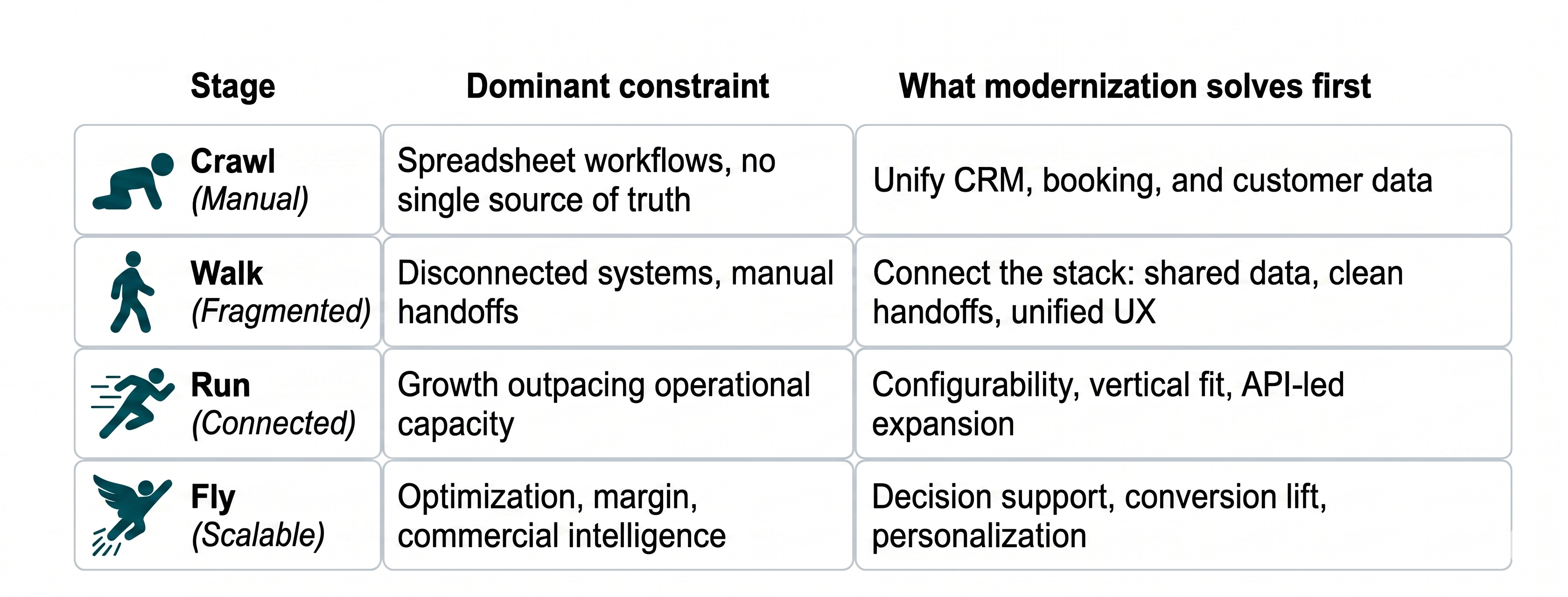
Kaptio views modernization as a maturity journey. Operators typically evolve from manual processes, to fragmented systems, to connected operations, and ultimately to a scalable business built for growth.
Rather than thinking about those stages as technology milestones, it can be more useful to think of them as Crawl, Walk, Run, and Fly. Each stage has a different bottleneck to overcome, a different priority to focus on, and a different path forward.
Crawl: To replace manual drag. (Manual)
The Crawl-stage operator is spreadsheet-heavy, siloed, and reactive. Quotes happen over email. Customer data lives in someone's inbox. Payment links are sent manually. The team is talented and the product is good, but the infrastructure was built for a smaller business than the one that now exists.
The priority is stabilization, not optimization. Reduce friction. Speed up quoting. Create one source of truth. Establish the foundational workflows that make everything else possible.
UK-based Travel Nation, a specialist in complex multi-destination FIT itineraries, lived at this stage. Before consolidating systems, the sales team was operating across email, spreadsheets, standalone itinerary tools, and manual payment processes - and enquiry response times had stretched to three weeks.
After unifying itinerary building, CRM, payments, and back-office workflows into one system, response times dropped to near-instant, enquiry-to-booking conversion for repeat clients hit 66%, and annual turnover grew 10%.
For an operator at this stage, the highest-leverage move is the simplest one: consolidation.
Walk: To connect teams and journeys. (Fragmented)
The Walk-stage operator has invested in modern tools, but those tools are not connected to each other. Sales has a CRM. Finance has accounting software. Operations has an itinerary builder. Marketing has an email platform. Each system works fine alone. The problem is the handoffs: A booking confirmed in sales has to be manually re-entered in operations, a customer change must be updated in three places, payments don't sync to booking records.
The priority is unification, not addition. The operator does not need more tools. They need the tools they already have to share data, workflows, and customer context. The goal is not to rip out every existing tool; that creates the disruption operators rightly fear.
The goal is a single connected layer that the rest of the stack plugs into, so data flows automatically and the team stops doing reconciliation work.
Run: To scale without operational chaos. (Connected)
The Run-stage operator has solved the connectivity problem and is growing fast. New brands, new product lines, new geographies, new distribution channels.
The priority is supporting growth without adding linear headcount. That means configurability - supporting different business models like FIT, group, cruise, rail, and experiential without forcing every product line into the same operational template.
It means API-led expansion, so the operator can connect new distribution partners and new payment providers without engineering projects every time. And it means phased rollout, because a fast-growing operator cannot pause the business for a migration.
Different multi-day business models genuinely operate differently.
A cruise booking has a different inventory logic than a group tour. A FIT itinerary has a different pricing model than an escorted product. A platform built to handle them - through combinations like Quest, Circle, and Voyage - supports growth without forcing operational compromises.
Fly: To optimize for growth, margin, and advantage. (Scalable)
The Fly-stage operator is already large or complex. The systems are in place. Growth is happening. The new question is whether the business can grow more profitably, intelligently, and with a better customer experience than competitors.
Priorities shift from foundational to commercial. Yield optimization. Conversion improvement. Operational observability. Margin performance. Revenue intelligence. Personalization at scale.
This is where advanced automation and decision intelligence matter most - not as futuristic capabilities, but as practical tools.
AI shows up here in operational, grounded ways: faster quoting, smarter packaging, decision support, identifying conversion bottlenecks, surfacing revenue opportunities the team would otherwise miss. The point is not to replace humans. It is to help the commercial team make better decisions, faster.
The Fly stage is also where the original modernization investment compounds.
Operators who built the right foundation at Walk and Run have data, workflows, and infrastructure that make optimization possible. Operators who skipped those stages and tried to leap straight to AI-powered everything tend to find the underlying data isn't clean enough to act on.
The question is not "which stage am I in?" but "what is the next-best move from where I am right now?"
Not sure which stage your business is in? See where you fit today and what your next-best move looks like with Kaptio.
Modernization Is About Adaptability
The next decade of multi-day travel will reward operators who can evolve quickly; not necessarily the ones who ran the biggest transformation project.
The most successful operators are not replacing everything at once. They are building on a unified foundation, modernizing in phases, and adding capabilities as the business evolves. That approach creates the flexibility to launch new products, expand into new channels, and support growth without rebuilding the stack every few years.
Crawl, Walk, Run, Fly. Every operator is somewhere on that journey. The challenge is not getting to the final stage overnight. It is identifying the next-best move for your business and taking it without disrupting what already works. That is what modular modernization at your own pace really means: not slower, but smarter.
Kaptio's unified platform supports multi-day operators at every stage of the maturity journey. Download the guide, Digital Maturity in Multi-Day Travel Guide, to learn how.





London, WC1N 2EB
Kópavogur, Iceland
Vancouver, BC, Canada, V6B 5C6

